
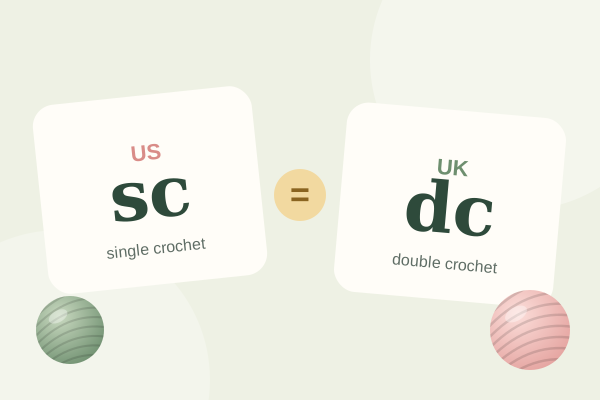
Crochet patterns are written in either US or UK terms, and the names differ by one step: the stitch the US calls a single crochet is a double crochet in the UK. Follow a pattern in the wrong system and your fabric will come out different from the design. This page is a quick reference you can keep open next to a pattern.
US and UK stitch names
| US name | US abbreviation | UK name | UK abbreviation |
|---|---|---|---|
| Chain | ch | Chain | ch |
| Slip stitch | sl st | Slip stitch | ss |
| Single crochet | sc | Double crochet | dc |
| Half double crochet | hdc | Half treble | htr |
| Double crochet | dc | Treble | tr |
| Treble (triple) crochet | tr | Double treble | dtr |
| Skip | sk | Miss | miss |
| Gauge | gauge | Tension | tension |
Notice that “dc” appears in both columns but means different stitches. That is the trap.
How to tell which system a pattern uses
- Look for the notes. Most designers state “US terms” or “UK terms” near the top. Check there first.
- Look for stitches that only exist in one system. “sc” or “hdc” means US; “htr” or “miss” means UK.
- If it only uses “dc” and “tr”, it could be either. Look at the photos and the stitch counts, or ask the designer.
- Check the designer’s country as a clue, not as proof.
Common abbreviations
| Abbreviation | Meaning |
|---|---|
| st / sts | stitch / stitches |
| rep | repeat |
| rnd | round (working in the round) |
| RS / WS | right side / wrong side of the work |
| inc | increase: usually two stitches worked into one stitch |
| dec | decrease: usually two stitches worked together (for example sc2tog) |
| BLO / FLO | back loop only / front loop only |
| sp or ch-sp | space, or the space made by a chain |
| MR | magic ring (a way to start rounds with a tight center) |
| beg | beginning |
Translating a line: an example
Take the US line “ch 3, dc in each of the next 4 stitches”. The stitch the US calls a double crochet is a treble (tr) in the UK, so the same line in UK terms reads “ch 3, tr in each of the next 4 stitches”. Going the other way, a UK “dc” is a US “sc”. Always convert the whole pattern, not single lines, and keep a note of which system you are using so you do not mix them.
Reading brackets and asterisks
- ( ) and [ ] usually group a set of stitches to be worked together or repeated, for example “(sc, ch 1, sc) in next st”.
- Asterisks mark a section to repeat: “*sc in next 3 sts, inc; rep from * around” means work everything after the first asterisk, then repeat it until the end of the round.
- A number in brackets at the end of a row, such as “(18)”, is the stitch count you should have when the row is done. Use it to check your work.
If a stitch count does not match, read common crochet mistakes for ways to find the slip. New to all of this? Start with the beginner roadmap.
Written by KindlyWis Editorial from standard, published conventions. We have not personally made or tested any patterns or projects mentioned here. Any pictures or diagrams are original illustrations, not photographs of finished work. Spot something wrong or unclear? Tell us and we will correct it.